NVIDIA GeForce GTX 485M SLI
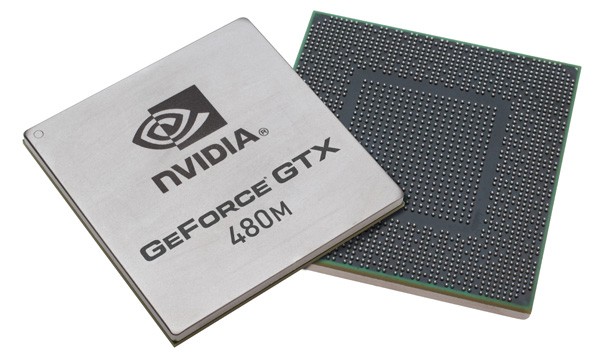
The NVIDIA GeForce GTX 485M SLI is a high-end graphics solution for laptops based on the two GTX 485M graphic cards in SLI mode. With SLI each card usually renders a single frame (AFR mode). Therefore, it may suffer from micro stuttering in low fps ranges of 30fps. This happens because of different timespans between two frames (e.g. two frames nearly at a time and afterwards a longer pause).
The GeForce GTX485M SLI supports the same features as a single GTX 485M card. Therefore, it supports DirectX 11 and is produced in 40nm at TSMC.
Other than the GeForce GTX 480M, the 485M is no longer based on a trimmed down GF100 chip, but on the related GF104, which is designed for the consumer sector and has 384 cores if completely used. More information on the GF104 core can be found on the GTX 485M page.
The performance of the Nvidia GeForce GTX 485M SLI is clearly better than the GTX 480M SLI and therefore it is the fastest graphics solution for laptops in early 2011. It allows the user to play all current games in high resolutions and detail settings with Antialiasing activated. Only Metro 2033 and Crysis may stutter with high Antialiasing and maximum details. Compared to a single GTX 485M, the SLI comibnation should be about 40% on average (with high details and Antialiasing). Compared to Crossfire solutions by AMD, the Nvdia SLI drivers are currently clearly better.
As the GeForce 300M series, the GeForce GTX 485M supports PureVideo HD with VideoProcessor 4 (VP4 with Feature Set C). This means the GPU is able to fully decode HD videos in H.254, VC-1, MPEG-2, and MPEG-4 ASP. Using Flash 10.1 the graphic card can also accelerate Flash videos.
What's new compared to the GF100 (480M) is support for Bitstream transfer of HD Audio (Blu-Ray) via HDMI in the GF104 chips. Alike the HD 5850, the GTX 485M can transmit Dolby True HD and DTS-HD via Bitstream to compatible receivers without quality loss.
The rendering cores of the Nvidia GeForce GTX 485M can be used for general calculations using CUDA or DirectCompute. E.g. the encoding for HD videos can be done significantly faster using the shader cores of the GPUs compared to modern CPUs. PhysX is also supported by the mobile Fermi to calculate physics effects in supported games. Furthermore, a single GTX485M can be used to calculate PhysX while the other card renders the game.
Compared to desktop GPUs, the Geforce GTX 485M is comparable to two Nvidia GeForce GTX 460 running in SLI combination
| Pipelines | 768 - unified |
| Core Speed * | 575 MHz |
| Shader Speed * | 1150 MHz |
| Memory Speed * | 1500 MHz |
| Memory Bus Width | 256 Bit |
| Memory Type | GDDR5 |
| Max. Amount of Memory | 2x2048 MB |
| Shared Memory | no |
| DirectX | DirectX 11, Shader 5.0 |
| Current Consumption | 100 Watt |
| Transistors | 6000 Million |
| technology | 40 nm |
| Notebook Size | large |
| Date of Announcement | 06.01.2011 |

Tidak ada komentar:
Posting Komentar